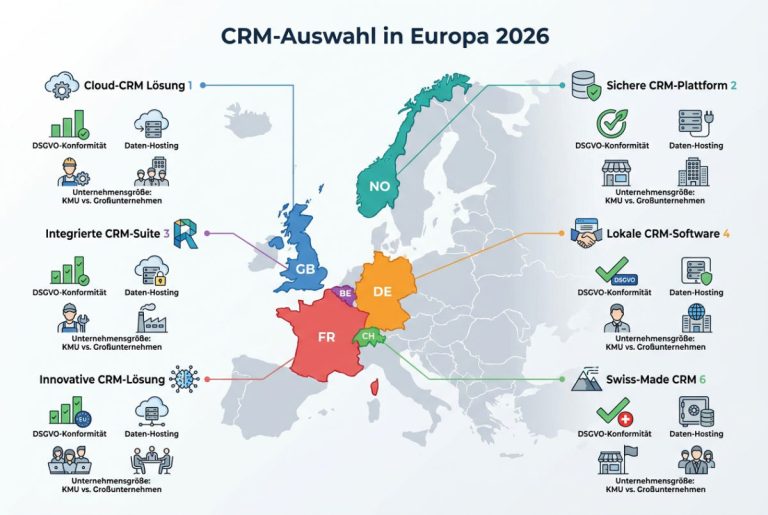

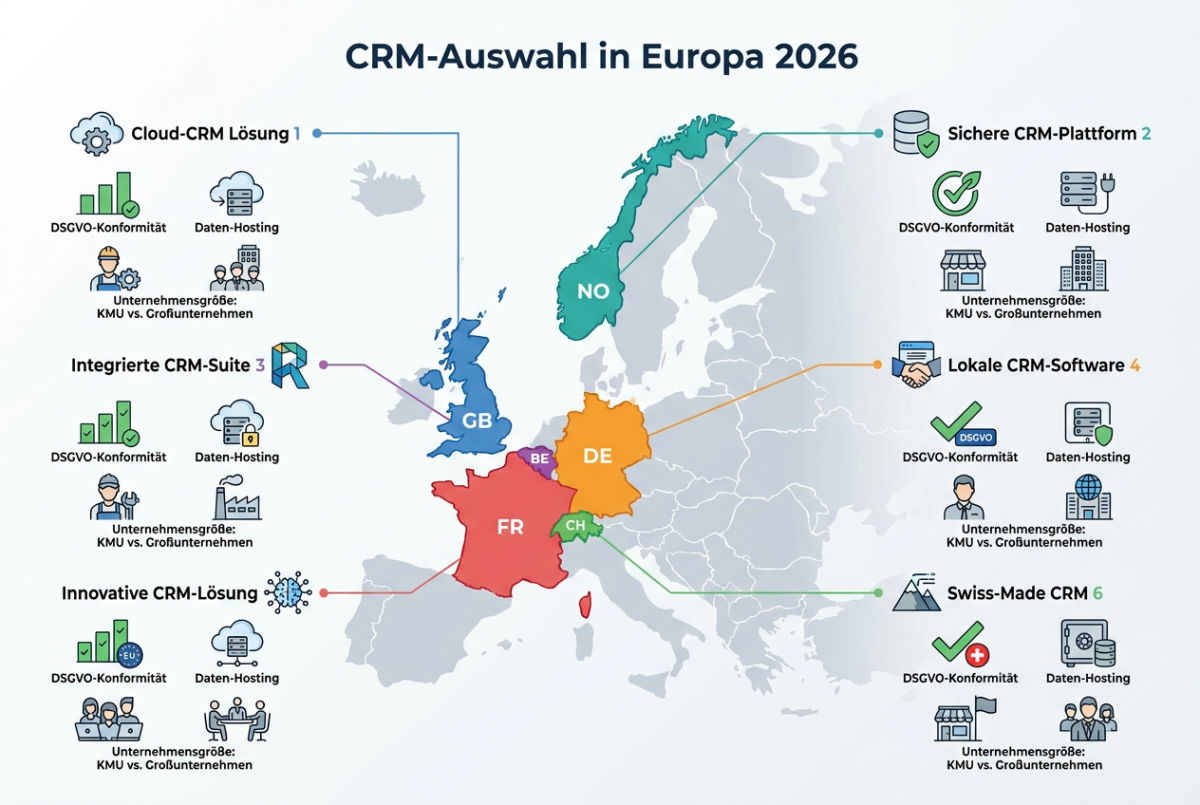
Search results for "European CRM alternatives" consistently point to a handful of named tools, and it's worth acknowledging them rather than staying purely abstract. Commonly cited examples include Attio (United Kingdom), SuperOffice (Norway), Efficy (Belgium), SAP CX (Germany), Brevo (France), BSI Software (Switzerland), and ADITO (Germany), alongside the open-source project Atomic CRM.
These names appear frequently across comparison articles and forum discussions — but frequency of mention is not the same as verified current fit for your use case. Pricing tiers, feature sets, and hosting details change, and country of origin doesn't automatically guarantee EU-only data residency (some vendors still route data through global infrastructure).
How to use this list responsibly
- Treat country-of-origin as one signal among several, not a decision criterion on its own
- Verify current hosting location and data processing terms directly with the vendor or via an up-to-date directory
- Cross-check whether a tool targets SMEs (e.g., Attio, Brevo) or enterprise pipelines (e.g., SAP CX, Efficy) before shortlisting
For current, verified listings by category and country, the euroboxx directory tracks vendor details that can change faster than static articles reflect.
European Alternatives to Marketing Automation Hubs vs Pure CRM Tools
Not every "European CRM alternative" search is actually about CRM in the strict sense. A significant share of comparison traffic — reflected in results like the European alternatives to HubSpot Marketing Hub roundup — is really about marketing automation: email campaigns, lead scoring, and nurture workflows rather than pipeline and deal management.
Tools such as Brevo, Webmecanik Automation, and Encharge (European origin worth verifying independently) sit in this adjacent category and often integrate with a CRM rather than replacing one. Sparklane, by contrast, is primarily a B2B sales intelligence and account-based marketing platform (data enrichment, buyer-intent signals) rather than a classic email/nurture automation tool — worth distinguishing from Brevo or Webmecanik when comparing options. This distinction matters for teams evaluating "European CRM alternatives" but actually needing marketing automation or sales intelligence functionality first.
Why the distinction matters for procurement
Buying a marketing automation platform expecting full CRM depth (or vice versa) is a common evaluation mistake. Marketing hubs typically excel at campaign orchestration and contact segmentation but offer lighter deal-tracking and forecasting than dedicated CRMs like Attio or SuperOffice.
Practical takeaway
Teams should first map whether their core need is sales pipeline management or marketing campaign automation — the "best" European alternative depends heavily on which side of that line the requirement actually falls.
Section 1: Why the CRM Decision Increasingly Includes a "Where Is My Data Hosted" Question
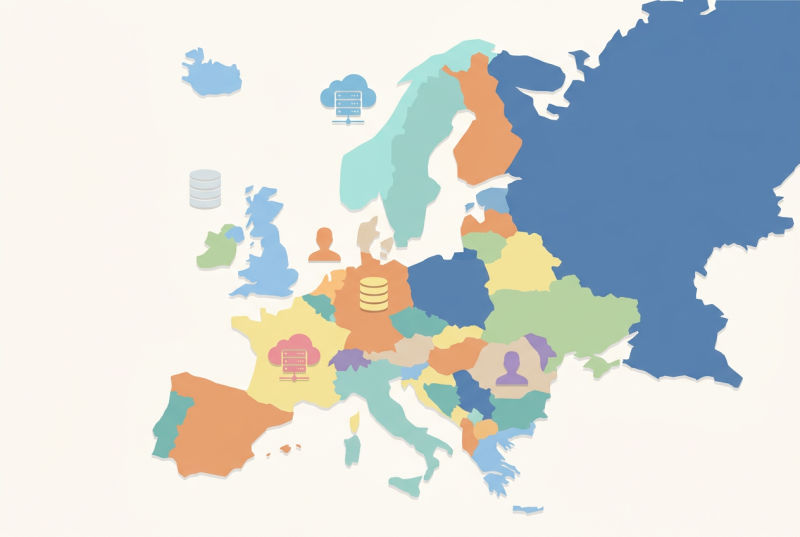
CRM selection processes at many European companies eventually reach a point where hosting location and contractual jurisdiction become as relevant as feature comparison. What used to be a purely functional decision — pipeline management, reporting, email integration — now regularly runs into questions from procurement or IT security about where customer data physically resides and which legal framework governs it.
This shift isn't a trend claim; it's tied to concrete structural factors: stricter internal compliance policies at EU organizations, sector-specific procurement rules (public sector, healthcare, finance), and lingering uncertainty around US Cloud Act exposure for data processed by American vendors like Salesforce, HubSpot, or Microsoft. Even when a US-based tool is technically GDPR-compliant, some teams still prefer a provider with EU-based ownership, hosting, and legal jurisdiction throughout.
This is also where open-source options like Atomic CRM enter the conversation — since self-hosting removes the "where is my data" question almost entirely, shifting responsibility (and control) to the team running the infrastructure, rather than a third-party vendor.
Two clarifications matter early on: not every "European" CRM is automatically GDPR-compliant, and being GDPR-compliant doesn't require a European vendor. This article treats hosting location as one practical filter among several — not an automatic advantage.
Section 2: What Actually Defines a "European CRM"?
The label "European CRM" gets used loosely, but it actually rests on three separate axes that matter differently depending on why a team is looking for an alternative in the first place.
- Ownership and headquarters – whether the company itself is legally based and controlled in Europe (e.g., Attio in the UK, SuperOffice in Norway, Efficy in Belgium), as opposed to a European-facing subsidiary of a US parent.
- Hosting and data residency – whether customer data is physically stored in EU/EEA data centers, regardless of who owns the company.
- Regulatory compliance – whether the tool meets GDPR requirements on paper, which is a baseline many vendors, European or not, can technically claim.
These distinctions matter because a tool can satisfy one axis without satisfying the others. A US-owned CRM hosted on EU servers may still fall under US jurisdiction through mechanisms like the CLOUD Act — a concern frequently raised in discussions comparing Salesforce, HubSpot, Microsoft, and Zoho to European vendors. This is part of why some teams explicitly distrust US CRM vendors' data practices: it's less about GDPR checkbox compliance and more about who can be legally compelled to hand over data, and under what circumstances. For public sector, healthcare, and finance procurement, this distinction often outweighs feature comparisons entirely.
Section 3: Common Reasons Teams Look for Alternatives to Salesforce, HubSpot, or Pipedrive
Teams rarely start evaluating European CRM alternatives out of ideological preference. The motivations tend to be operational and recurring:
- Data residency and jurisdiction requirements – internal compliance policies or public-sector procurement rules that explicitly exclude US-owned processors, regardless of GDPR-compliance claims.
- Pricing complexity and currency exposure – Salesforce and HubSpot list prices are USD-denominated, and enterprise tiers often accumulate add-on costs (automation limits, API calls, seat-based surcharges) that are hard to forecast.
- Support quality and timezone alignment – some EU-based teams report anecdotally slower response times or limited language coverage from US-headquartered support structures, though this varies by vendor and hasn't been formally benchmarked.
- Feature bloat versus actual need – many SMEs use a fraction of Salesforce's or HubSpot's functionality and prefer leaner tools like Attio or SuperOffice that map more directly to their workflow.
- Strategic preference for European vendors – some organizations factor in supporting regional tech ecosystems, particularly in public-sector-adjacent industries.
Pricing Transparency as a Selection Criterion
Vendors such as BSI Software have marketed transparent, fixed pricing and faster implementation as differentiators against Salesforce's tiered, negotiation-heavy contracts — a positioning claim worth verifying against current vendor materials rather than treated as a fixed fact. This matters practically: unpredictable pricing makes budgeting difficult for smaller teams, while opaque implementation costs can erase any switching savings. Enterprises tend to weigh compliance and data residency more heavily; SMEs typically prioritize cost predictability and simplicity — a distinction worth clarifying before comparing vendors directly.
Section 4: Comparing European CRM Alternatives by Use Case
Rather than ranking tools by feature count, it helps to sort European CRM alternatives by the use case they actually fit — since a lightweight tool like Atomic CRM and an enterprise suite like SAP CX or Efficy solve fundamentally different problems, even though both get lumped into "Salesforce alternatives" lists.
| CRM Category | Typical Fit | Hosting Focus | Best For | Example (requires verification) |
|---|---|---|---|---|
| Enterprise-grade European CRM suites | Complex sales pipelines, multi-department use | EU data centers | Mid-size to enterprise B2B | SAP CX, Efficy |
| Lightweight European CRM tools | Simple contact/deal tracking | EU-hosted | Freelancers, small teams | Attio, SuperOffice |
| Industry-specific European CRM | Sector compliance (finance, healthcare, public sector) | EU-hosted, sector-certified | Regulated industries | BSI Software |
| Open-source European-hosted CRM | Full customization control | Self-hosted or EU cloud | Technical teams, agencies | Atomic CRM |
The examples above reflect names that recur across current comparison sites and forum discussions, but pricing tiers, certifications, and feature depth change frequently enough that they should be checked against a live, maintained directory rather than treated as fixed facts. For an up-to-date, side-by-side view — including vendors not covered here — the euroboxx directory's CRM category is a more reliable starting point than any static list, including this one.
Section 5: Migration Considerations – What Switching Actually Involves
Switching from Salesforce, HubSpot, or Pipedrive to a European CRM alternative is rarely a weekend project, but it's also less disruptive than many teams initially fear — provided the steps are sequenced correctly.
- Data audit and cleanup – Remove duplicate records, archive stale deals, and standardize fields before anything gets exported. Migrating messy data just recreates the same problems in a new system.
- Field mapping – Map custom fields, pipeline stages, and tags between the old and new CRM structures. This is where tools like Attio, Efficy, or Atomic CRM differ most from Salesforce's object model, so expect some manual reconciliation.
- Integration testing – Verify that email, marketing automation (e.g., Brevo, Webmecanik), invoicing, and support tools reconnect properly before full rollout.
- Parallel run period – Operate both systems briefly to catch mapping errors without disrupting active sales cycles.
- Team training and workflow adjustment – Even feature-comparable tools require behavioral change; budget time for this explicitly.
As a rough, non-verified estimate: small teams with under 500 contacts and clean data typically complete migration in 1–3 weeks, while larger datasets with custom fields and multiple integrations often take 6–12 weeks. Common failure points include incomplete field mapping and underestimated integration re-work — both are worth over-preparing for rather than rushing.
Section 6: How to Evaluate Whether a European CRM Alternative Is the Right Fit
Choosing among European CRM alternatives comes down to a handful of criteria rather than a single "best" answer:
- Data residency requirement – Is EU hosting a hard compliance mandate (public sector, healthcare, finance) or a soft preference?
- Integration ecosystem – Does the tool connect cleanly with existing email, invoicing, and marketing automation stacks, or will custom development be required?
- Team size and pipeline complexity – Lightweight tools like Attio or Atomic CRM suit small teams with straightforward deal flows; enterprise suites like SAP CX or Efficy suit multi-department sales operations.
- Budget structure – Transparent, EUR-denominated pricing (a point BSI Software and others market on) versus tiered, USD-based pricing with add-on creep.
It's worth being honest about limitations here: European CRM tools vary widely in maturity compared to established incumbents. Attio and Atomic CRM, for instance, are younger and less feature-dense than Salesforce. For teams with deeply customized, tightly integrated Salesforce ecosystems, migration cost may currently outweigh compliance benefits — staying put can be the more pragmatic short-term choice.
Comparing multiple vetted options side by side, rather than researching vendors ad hoc, meaningfully reduces selection risk and surfaces trade-offs faster.
Section 7: Getting Support With the Decision
Choosing between European CRM alternatives ultimately depends on a combination of factors covered throughout this guide: hosting requirements, team size, integration complexity, and how much weight compliance carries in the final decision. There isn't a single "best" European CRM — Attio suits lean, fast-moving sales teams, Efficy and SAP CX serve more complex enterprise workflows, while Atomic CRM appeals to technically capable teams wanting full control over hosting and customization.
Rather than relying on static "best of" lists that go stale as pricing and features shift, it's worth comparing current, verified listings side by side. The euroboxx directory tracks European CRM and marketing automation tools by category, hosting region, and target company size, making it easier to shortlist candidates that match specific compliance or integration requirements without wading through outdated vendor roundups.
Teams evaluating European CRM alternatives can browse current listings and comparisons in the euroboxx directory, or reach out directly with specific compliance or integration requirements for guidance on suitable options — no sales pressure, just a starting point for narrowing the field.
FAQ Section
Is a European CRM automatically GDPR-compliant?
No. GDPR compliance depends on data processing agreements, subprocessor transparency, and hosting practices — not headquarters location alone. A European-owned CRM hosted on US-based infrastructure can still raise compliance questions, while some non-European vendors offer EU-hosted, GDPR-compliant instances. Ownership, hosting, and compliance are three separate axes worth checking individually.
Can a European CRM integrate with US-based tools like Google Workspace or Microsoft 365?
Generally yes — most European CRM alternatives, including Attio, SuperOffice, and Efficy, support standard integrations with common email and productivity suites. However, integration depth varies by provider and pricing tier, so this should be verified against current documentation rather than assumed.
How long does switching CRM providers typically take?
For small teams with under 500 contacts and clean data, migration typically takes 1–3 weeks. Larger datasets with custom fields and multiple connected tools often require 6–12 weeks. These are estimates, not verified benchmarks, and actual timelines depend heavily on data quality and integration count.
Are European CRM alternatives more expensive than Salesforce or HubSpot?
This varies considerably by provider and tier. Some vendors market transparent, predictable pricing as a differentiator, but no universal pricing pattern can be stated without checking current rate cards for specific tools.
Further Reading
Choosing between European CRM alternatives is rarely a one-time decision — it connects to broader questions about compliance, tooling, and vendor selection that extend beyond CRM alone. The following resources offer additional context for teams working through related decisions:
- [European AI tools comparison] – For teams evaluating CRM add-ons or adjacent AI-powered sales and marketing tools built or hosted in Europe, this comparison covers similar sovereignty and integration considerations.
- [GDPR compliance checklist for B2B software procurement] – A practical checklist for verifying data processing agreements, subprocessor disclosures, and hosting claims — useful groundwork before shortlisting any CRM, European or otherwise.
- [European tech directory – browse CRM category] – Current, vetted listings of European CRM and marketing automation vendors, updated as the market shifts, rather than a static list that ages quickly.
Together, these resources support the same underlying goal as this guide: making CRM and adjacent software decisions based on verified hosting, ownership, and compliance details — not assumptions tied to a vendor's marketing language or country branding alone.
A Note on Vendor Names, Pricing, and Freshness
Named tools referenced throughout this guide — Attio, SuperOffice, Efficy, SAP CX, Brevo, BSI Software, ADITO, Atomic CRM, and others — reflect commonly cited examples in current European CRM comparisons. Feature sets, pricing tiers, and integration capabilities change frequently, so treat every specific claim about a vendor as a starting point for verification rather than a final data point. Checking a provider's current pricing page, subprocessor list, and hosting documentation directly remains the only reliable way to confirm details before a procurement decision.
This guide also avoids year-specific market claims ("in [year], the CRM market…") since vendor rankings and feature parity shift faster than most published comparisons can track. Where pricing is discussed, it's framed structurally — currency exposure, tier complexity, add-on creep — rather than as fixed figures, because concrete pricing without a verified source risks becoming misleading within months.
For readers cross-referencing this topic against other European software comparisons, this article is intended to complement rather than duplicate existing coverage of European AI tools and directory-based vendor listings, linking into that broader research rather than repeating it.