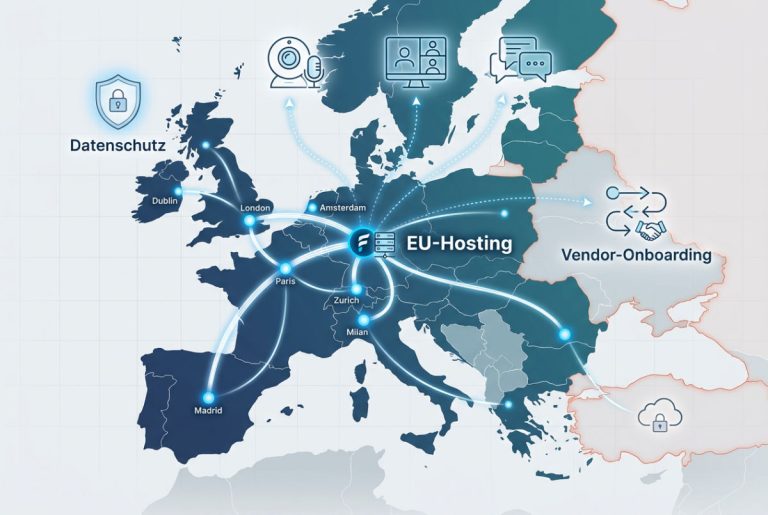

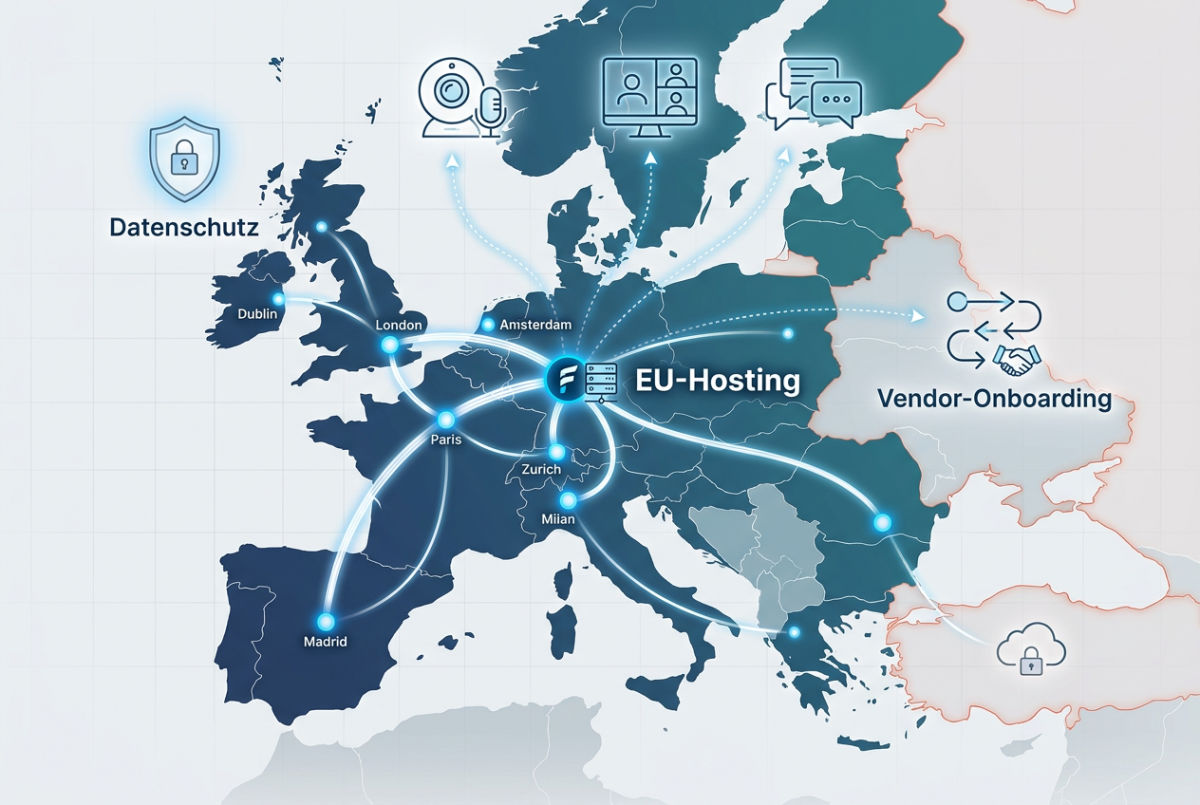
A server in Frankfurt automatically protects you from the US CLOUD Act – that assumption is too simple, and it regularly costs companies time during compliance review. Server location alone doesn't decide the outcome: what matters is which legal entity operates the service, which jurisdiction it falls under, and whether it has possession, custody, or control of the data. A US parent company is an important risk factor, but not an automatic disqualifier – conversely, a European headquarters doesn't automatically protect against access risk either. The CJEU's 2020 Schrems II ruling invalidated the Privacy Shield, but it did not ban Standard Contractual Clauses or US services in general; since 2023, the EU-US Data Privacy Framework can also serve as an adequacy basis for certified US providers. Data protection officers therefore assess these situations case by case, even when metadata and subprocessors sound European.
The business cost of such a rejection is still real: vendor onboarding stalls until an alternative has been evaluated, and in public tenders (RFPs), a missing data-residency commitment can lead to formal disqualification of a bid. How long a reassessment or migration actually takes depends heavily on the procurement process, integrations, and contract terms – blanket figures in weeks or quarters are project-specific estimates rather than market benchmarks.
This article provides a solid framework for that: evaluation criteria beyond the "European" label, a fact-based provider overview, and a decision framework for when switching actually makes sense – and when it doesn't.
Why Server Location Is Only Part of the Assessment
GDPR-compliant and EU-hosted are two different claims that are often used interchangeably. GDPR compliance isn't established by a Data Processing Agreement alone; it also depends on the lawful basis, allocation of roles, the Article 28 contract, security measures, deletion policies, data subject rights, and, where relevant, a valid third-country transfer mechanism. EU-hosted, by itself, only describes where specific data is physically processed – it doesn't automatically guarantee exclusively European legal jurisdiction, nor does it rule out non-EU support providers or subprocessors.
For video conferencing, this distinction matters a great deal, because it isn't a single dataset being processed but several separate data streams with different risk profiles: real-time audio and video signals, metadata (participant lists, IP addresses, connection timestamps), and stored recordings along with automatically generated transcripts. A provider might process the live signal within the EU while running transcription through a US-based AI API – a pattern that gets overlooked again and again in compliance reviews.
The subprocessor trap is exactly this point: an EU headquarters doesn't automatically protect against data flows through third parties outside the EU. A provider based in Germany can still source speech recognition, CDN services, or support ticketing systems from US companies. The table below shows where the four core data categories of a video conference are typically processed and what to check for.
| Data category | Typical processing location | What to check |
|---|---|---|
| Audio/video livestream | Often EU data centers, depending on routing via regional servers | Verify encryption type and server location in the DPA |
| Metadata (participants, IP, timestamps) | Often handled separately from the media stream, sometimes by third parties | Check the subprocessor list for non-EU vendors |
| Recordings | Cloud storage, often separately configurable | Have storage location and deletion periods specified in the contract |
| Transcripts/AI summaries | Often processed via external speech-recognition APIs | Check whether the transcription service is operated within the EU |
For a deeper assessment of whether a provider correctly classifies AI features relevant under the EU AI Act (such as automatic transcription or meeting summaries), it's worth reading our guide on how to evaluate EU AI Act compliance in European software.
Leading European Video Conferencing Providers Compared
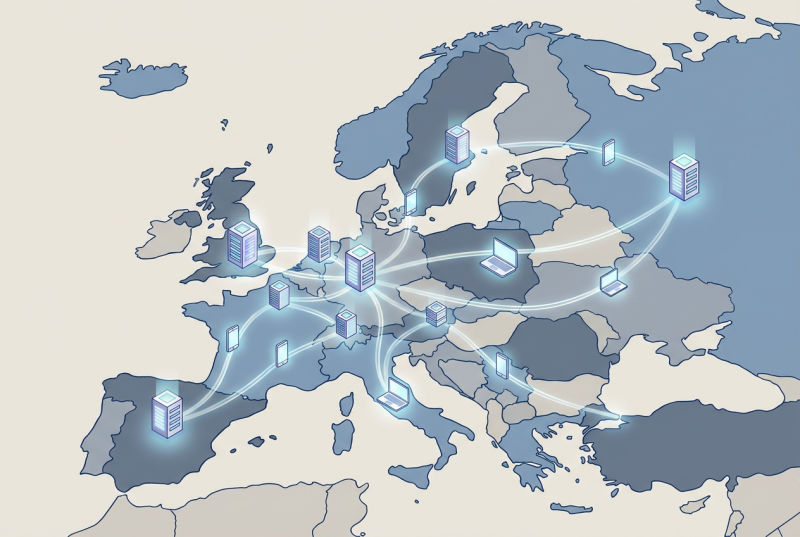
The comparison below focuses first on target audience, encryption approach, and each provider's biggest practical limitation – it's a functional shortlist, not a complete compliance comparison. Hosting location, subprocessors, integration ecosystem, and pricing model still need to be checked separately for the specific plan and deployment model you choose. There's no blanket winner anyway, since these providers serve different use cases – from small teams to government agencies with strict security requirements.
| Provider | Target audience | Encryption | Biggest limitation |
|---|---|---|---|
| OpenTalk | Mid-sized companies, public administration (Germany) | Transport encryption, part of the Heinlein Group | Smaller feature set compared to Zoom Enterprise |
| Digital Samba | Developers, SaaS providers with API integration | Transport encryption | Focused on embedding rather than a standalone client app |
| Tixeo | Government agencies, law firms, security-critical industries | End-to-end encryption, including multipoint conferences | Higher cost, smaller partner ecosystem |
| Nextcloud Talk | Organizations with existing Nextcloud infrastructure | End-to-end encryption optional (1:1 calls) | Limited scaling for large group conferences |
| alfaview | Companies focused on large participant counts per tile | Transport encryption, proprietary codec technology | Lower international recognition, fewer integrations |
| Whereby | Small teams, browser-based ad-hoc meetings | Transport encryption | Limited enterprise admin features |
| Jitsi (self-hosted) | Technically skilled teams, open-source-oriented organizations | Depends on your own server configuration | Operation and maintenance rest entirely with the user |
A pattern emerges from this comparison: the more a provider emphasizes end-to-end encryption and sovereign hosting architecture (Tixeo, for instance), the smaller its integration and feature ecosystem tends to be compared with Zoom or Teams. Conversely, providers with broader feature sets, like alfaview or Digital Samba, often offer "only" transport encryption rather than genuine end-to-end protection. Nextcloud Talk positions itself as a sensible add-on for organizations already using Nextcloud as their collaboration platform – a point that becomes relevant alongside our EU cloud storage checklist.
Jitsi is one option offering full infrastructure control for teams that want to self-host – but it isn't the only one: Nextcloud Talk and OpenTalk can also be self-operated, and some enterprise providers such as Tixeo offer on-premises or private-cloud models depending on the contract. Self-hosting only guarantees full control, in any case, if the services it depends on – STUN/TURN servers, push notifications, identity providers, or support access – also remain within your own area of responsibility. Choosing Jitsi means shifting security and availability entirely onto your own IT department.
For context: Whereby is based in Norway, which makes it part of the EEA rather than the EU; Jitsi is primarily an open-source software option rather than a conventional provider in the sense of the rest of this table. The terms "European," "EU," and "EEA" aren't interchangeable and should be distinguished case by case. Encryption modes, participant limits, hosting options, and enterprise features also vary by version, plan, and deployment model (SaaS, private cloud, on-premises) – verify current details directly with the providers before making a decision.
Evaluation Criteria: What Decision-Makers Should Really Look At
The label "European" alone says little about a provider's actual suitability. A solid assessment comes down to the following criteria:
- Certification standards: ISO 27001 serves as a baseline proof of information-security management; for German government agencies and regulated industries, the BSI C5 attestation is also relevant – a German standard, not an international minimum. If neither is in place, the provider should be able to produce alternative evidence (audit reports, penetration test results).
- Interoperability: Connecting to existing calendar and collaboration tools (Outlook, Google Calendar, Nextcloud) should happen through native plugins, not manual scheduling – otherwise growing teams end up with a noticeable administrative burden.
- Scalability: A provider suited to a 20-person project team needs different technical headroom than a 500-person town hall. The maximum number of simultaneous participants should be fixed in the contract, not just advertised.
- Handling of recordings and transcripts: Storage location, contractually agreed deletion periods, and whether transcription runs through an internal or external service should all be documented.
- End-to-end encryption: For most European providers, it's optional or limited to 1:1 calls – genuine multipoint E2E encryption is currently offered by only a few providers, such as Tixeo. It mainly protects media content, but says little about endpoint security, identity management, metadata protection, tenant isolation, or administrative access – and it can limit server-side recording, transcription, or dial-in functions.
- GDPR-compliant by design vs. by contract: A provider that ensures data protection through architecture (e.g., EU-only infrastructure with no third-country subprocessors) offers a higher level of protection than one that guarantees compliance solely through a Data Processing Agreement.
Every one of these criteria belongs in a vendor assessment individually, rather than relying on blanket marketing claims like "GDPR-compliant."
When Does Switching to a European Solution Actually Pay Off – And When Doesn't It?
Regulatory requirements are often the strongest reason to switch, even though GDPR itself doesn't impose a general obligation to store data within the EU. Additional requirements frequently come from national law, professional confidentiality obligations, sector-specific rules, procurement conditions, or individual contracts – most commonly for government agencies, law firms, healthcare, and the financial sector, but not automatically as a blanket exclusion of US-based cloud infrastructure. A required "sovereign cloud" also isn't defined solely by a provider's European origin, but by operator control, administrative access, key management, and technical dependencies – that should be assessed case by case, not assumed across the board. Organizations already standardized on European infrastructure – Nextcloud or EU-based mailbox providers, for instance – benefit further from lower integration effort.
Different factors favor a global heavyweight like Zoom or Microsoft Teams. Very large webinars with 5,000 or more simultaneous attendees currently aren't supported with comparable stability by most European providers. Deep, native integration with Microsoft 365 or Google Workspace – automatic calendar sync across multiple departments, for example – tends to be more mature among US providers. And for international stakeholders already familiar with the Zoom or Teams interface, switching creates additional friction.
Switching costs are a legitimate factor here, not an excuse: training effort, adapting existing integration workflows, and potentially running both systems in parallel during the transition all create real costs that must be weighed against the regulatory benefit. An organization without strict compliance requirements and with a heavily M365-centric infrastructure may make a worse business decision by switching hastily than by deliberately staying with Zoom or Teams under tightened contractual terms.
What Actually Changes When You Migrate From Zoom or Teams
A migration can be planned realistically once scope and dependencies are known upfront – but how long it takes depends heavily on approval processes, integrations, data volume, and user groups, and should be treated as a project-specific estimate rather than a market benchmark. For smaller teams with limited integration depth, a timeframe of a few weeks can be realistic if SSO and calendar plugins are already prepared. For enterprise rollouts with accumulated legacy dependencies, multiple departments, and existing recording archives, the process tends to take considerably longer.
The following dependencies largely determine the timeline:
- Identity provider migration: Single sign-on must be switched to the new provider and reconciled with existing Active Directory or Microsoft Entra ID structures (formerly Azure AD).
- Calendar plugin updates: Outlook and Google Calendar integrations need to be reconfigured for the new provider, usually including a rollout to all endpoint devices.
- Retraining for recording and transcription: Employees often need a short briefing, since recording and transcription features work differently with European providers than with Zoom or Teams.
- Running in parallel: A transition period running both systems side by side reduces the risk of missed meetings during the cutover; the right duration depends on team size and how business-critical the meetings are.
Before the existing contract ends, it should be contractually clarified which recordings, transcripts, chats, whiteboards, and user/audit data can be exported, in what format, and when the provider will return or delete them. With Teams, contacts often live in Microsoft Entra ID or Exchange anyway rather than in the video service itself – that should be checked separately too. Deletion periods vary considerably by contract, product, configuration, and data type.
Frequently Asked Questions About European Video Conferencing Tools
Is Zoom GDPR-compliant?
Zoom offers a Data Processing Agreement and, in some cases, EU data centers. As a US company, though, Zoom is generally subject to US jurisdiction, which can become relevant if Zoom has possession, custody, or control of certain data – regardless of the physical server location. That doesn't automatically mean a GDPR violation: since 2023, the EU-US Data Privacy Framework can serve as an adequacy basis for certified providers, and Standard Contractual Clauses remain a valid instrument too. Many data protection officers still treat this setup as requiring review and ask for a case-by-case transfer risk assessment.
What's the most secure European video conferencing tool?
Providers with consistent end-to-end encryption even for multipoint conferences, like Tixeo, secure media content to a high standard, at least. That alone doesn't make a product the most secure overall package, though: identity management, endpoint security, metadata protection, tenant isolation, and administrative access all matter just as much. Actual suitability also depends on certifications, subprocessors, and the specific use case.
Can European tools integrate with Microsoft Teams or Google Workspace?
Many European providers offer calendar and SSO integrations for Microsoft 365 and Google Workspace, though usually with less functional depth than native Zoom or Teams add-ins. Fully replacing your collaboration suite generally isn't possible this way.
Are open-source platforms like Jitsi a realistic alternative?
Jitsi is a serious option for technically capable teams with their own server infrastructure. Full control over hosting and data comes at a price, though: operating, securing, monitoring, and maintaining availability all become the organization's own responsibility.