

Why the Question of a European AI Writing Tool Comes Up at All
Content teams that introduce an AI writing tool usually run into a question from the legal department faster than from the editorial team: where exactly is the text – and the data it is generated from – processed? Many AI writing services, including well-known tools such as ChatGPT, Jasper, Copy.ai, and Writesonic, are operated by US-headquartered vendors or rely on US-based subprocessors. However, the actual storage and inference locations vary by product, pricing plan, cloud region, and contract, and some enterprise offerings provide regional processing controls. The user's own location says little about where the data actually ends up. This is not only a data-residency and documentation problem; it also raises genuine technical and organizational security questions around access controls, data retention, incident response, and the risk of confidential inputs being exposed or reused.
The practical friction shows up in review cycles. A standard software procurement review in a mid-sized organization can take anywhere from a few days to several weeks, depending on how quickly legal can assess a new SaaS vendor's data processing agreement (DPA), subprocessor list, and international transfer mechanism, and on how sensitive the data involved is. For AI writing tools specifically, this review is sometimes triggered a second time when a vendor changes its underlying model provider, which can affect the processing chain even without a change in the visible product. Editorial teams operating on daily or weekly publishing cadences can experience this as a mismatch between fast content cycles and slower procurement timelines. This is also where the terms "European AI writing tool" and "EU AI Act compliant" start to overlap in search behavior, though they are not the same question. A closer breakdown of the regulatory side is covered separately in this guide to evaluating EU AI Act compliance in European AI software.
What Actually Makes an AI Writing Tool "European"?

There is no single legal definition of a "European AI writing tool." A tool is best assessed by checking three separate factors independently: company headquarters, location of data processing, and the origin of the underlying language model. None of these three automatically implies the other two, and marketing pages rarely make the distinction explicit. It also matters whether "European" is meant to describe the EU, the wider European Economic Area (EEA), or Europe more broadly — the United Kingdom, Switzerland, and other European countries outside the EU/EEA have their own data protection and transfer regimes that do not automatically follow EU rules.
- Company headquarters: Where the vendor is legally incorporated (e.g., Germany, France, the Netherlands). This determines which corporate law and tax jurisdiction applies but says nothing about where servers are located or which AI model generates the text.
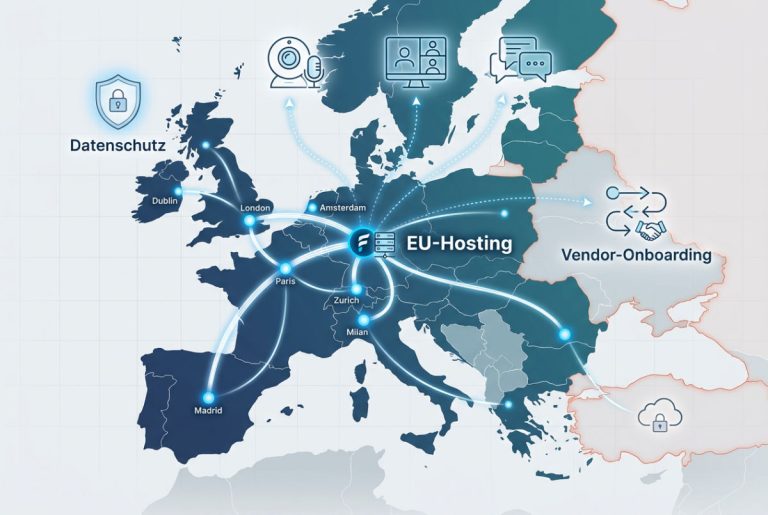
- Location of data processing: Where prompts, drafts, and account data are actually stored and processed. A tool can be developed by an EU-based company while still processing data via a US cloud region unless the contract explicitly states an EU/EEA-only hosting commitment.
- Model origin: Whether the writing tool runs its own trained language model, licenses an EU-developed model, or calls a US-based foundation model (e.g., via API) in the background. This is the factor most often left out of vendor marketing.
- "Hosted in Europe" vs. "developed in Europe": The first refers only to server location; the second refers to where the software and, ideally, the model were built. A tool can be hosted in an EU data center while running a non-EU model, and vice versa.
- Three realistic combinations found in the market: EU company + EU-developed model; EU company + non-EU (typically US) model accessed via API; EU company + hybrid setup combining EU infrastructure with a licensed or open-source model.
Obligations under the EU AI Act are assigned primarily by an organization's role — for example as a provider of a general-purpose AI (GPAI) model, a provider of an AI system, or a deployer — and by whether that model or system is placed on or used in the EU market. The country where a model was originally developed is not itself the deciding factor. A writing-tool vendor that integrates a third-party general-purpose AI model may need certain information from that model's provider and can have its own system-level obligations, but it does not automatically inherit the model provider's GPAI transparency and documentation duties simply because the vendor is headquartered in the EU.
Why European Organizations Review Alternatives to US Tools
The interest in alternatives is typically a risk-management exercise rather than a preference for one region over another. Three drivers recur across sourcing reviews.
First, cross-border transfers of personal data require a valid legal basis under Chapter V of the GDPR. Where an adequacy decision applies to the destination country, transfers can generally proceed without Standard Contractual Clauses (SCCs) or a separate transfer impact assessment. Where SCCs or another Article 46 safeguard is used instead, the organization exporting the data needs to assess whether that safeguard is actually effective for the destination in question and add supplementary measures if necessary; a data protection officer often logs several hours of additional work per new vendor for this, depending on the complexity of the subprocessor chain. This transfer regime concerns personal data specifically; transfers of confidential but non-personal business data are governed mainly by contractual terms, security requirements, and any applicable sector-specific rules, not by the GDPR transfer mechanism itself. Second, concentration risk becomes a factor when several core business tools already depend on the same one or two large US cloud providers; adding an AI writing tool from the same stack increases single-vendor exposure rather than diversifying it. Third, sourcing policies in the public sector and in regulated industries – finance, healthcare, legal services – often set a formal or informal preference for EU/EEA-based processing as part of broader vendor-risk frameworks, not as a blanket rejection of non-EU software.
| Driver | Typical trigger | Practical impact |
|---|---|---|
| Data transfer & safeguards | New vendor uses a non-EEA processor | DPO review of the transfer mechanism per vendor |
| Vendor concentration | Multiple core tools on one cloud provider | Added item in risk register, not a blocker |
| Sector sourcing policy | Public sector, finance, health, legal | EU/EEA-hosting preference in tender criteria |
| Contract renewal cycle | Annual or 2-year SaaS renewal | Natural checkpoint to re-run vendor assessment |
None of this amounts to a universal rule that EU tools are safer or US tools riskier. It is a weighting exercise specific to each organization's risk tolerance, contract renewal schedule, and sector obligations.
Evaluation Criteria for European AI Writing Tools
Product names, pricing tiers, and feature lists change too frequently to serve as a stable comparison basis; a table built on today's marketing page can be outdated within a single quarter. A criteria-based checklist provides a more durable foundation for internal evaluation than a static product comparison, and this guide focuses on that procurement and data-governance process rather than on ranking individual products.
Five practical checks form the core of a compliance-oriented review:
| Criterion | What to verify | Where to find proof |
|---|---|---|
| Company headquarters | Legal entity and registration country | Imprint, DPA signatory details |
| Processing location | Data center region for storage and processing | Subprocessor list, DPA Annex |
| Model origin | Proprietary, licensed, or third-party API model | Vendor’s AI/model documentation page |
| Training data transparency | Whether customer input is used for model training by default | Terms of service, opt-out clause |
| Contract terms | Retention period, deletion process, liability caps | DPA, Master Service Agreement |
Three checks are useful screening gates before going further: confirming the current subprocessor and processing chain, obtaining written terms on whether prompts and drafts are used for model training (with an opt-out clause if they are), and identifying the specific foundation model in use rather than accepting a description of "advanced AI" or "proprietary technology." These checks are a starting point, not proof of compliance on their own. A fuller review should also cover the data types and purposes involved, the controller/processor roles, the lawful basis where personal data is processed, retention and deletion procedures, security controls, data-subject rights, and whether a Data Protection Impact Assessment or a transfer assessment is required for the specific use case. How long this takes depends heavily on how quickly and completely the vendor provides documentation, and on the complexity of the subprocessor chain — a well-documented, low-risk case can be cleared quickly, while a case requiring additional requests or legal negotiation can take considerably longer.
Vendor-to-vendor comparisons based on public marketing pages carry a specific limitation: pricing, model versions, and hosting arrangements are updated by providers without public changelogs. Any comparison used for a purchasing decision should be re-verified directly with the vendor's current DPA rather than relying on third-party summaries, including this one. For an initial shortlist of Europe-headquartered writing assistants, options such as DeepL Write, LanguageTool, and neuroflash are commonly cited starting points; the legal entity, processing region, subprocessors, and model provider should still be verified for the specific plan under consideration. Beyond compliance, finalists are worth comparing on representative writing tasks, language coverage, factual reliability, editorial controls, integrations, ease of use, and total cost, since these factors determine whether a tool is actually fit for editorial work.
European Tool or US Alternative: When Does Which Choice Make Sense?
Neither option is universally correct; the right choice depends on which constraint weighs more heavily for a given organization, and on the specific product and plan rather than on the vendor's nationality alone. A European tool tends to be the better fit under several conditions: strict data-residency requirements written into internal policy or client contracts, public-sector procurement rules that name EU/EEA processing as a tender criterion, operation in a regulated industry (finance, healthcare, legal) where a specific law, contract, or internal policy calls for it, and a general strategic goal of reducing dependency on a small number of large US cloud and AI providers. It's worth noting that even a binding EU data-residency requirement can, in principle, be met by a non-EU vendor that offers an appropriate regional deployment — the requirement is about where data is processed, not automatically about where the vendor is headquartered.
A non-European tool can remain the pragmatic choice depending on the specific model, version, and deployment: some large foundation models are updated frequently, support very large context windows for handling long documents, or offer strong multilingual output across major world languages. These characteristics vary by product and version rather than reliably tracking the vendor's country of origin. Several European vendors have narrowed performance gaps by combining EU-based infrastructure with a licensed or open-source model rather than training a fully proprietary model from scratch — a hybrid approach that can help satisfy data-residency requirements without necessarily limiting model capability, though results still need to be tested for the specific use case.
A realistic assessment avoids declaring a universal winner. Organizations with no regulatory pressure and no data-residency mandate often see limited practical benefit from switching if their current tool already satisfies its existing DPA terms. Organizations subject to sector-specific sourcing rules or contractual residency commitments, by contrast, may find that a European-processed setup is effectively required, regardless of feature parity — but this should be traced back to the specific law, tender, client contract, or internal policy that applies, rather than assumed from general reputation. Teams evaluating CRM systems alongside content tooling face a structurally similar decision process, covered separately in this overview of European CRM alternatives for GDPR-conscious B2B teams.
Checklist Before Switching AI Writing Tools
A tool switch should be treated as a procurement decision with defined verification steps rather than a trial-and-error rollout. The following sequence reflects checks that typically surface compliance gaps before contract signature; actual timelines for each step will depend on the organization's own approval process and the vendor's responsiveness rather than on a fixed industry average.
- Request the full subprocessor list and confirm in writing where data processing actually occurs, not merely that the vendor "supports" EU customers.
- Clarify default training data usage: ask explicitly whether input text is used to train or fine-tune models by default, and whether an opt-out is contractually guaranteed rather than described as a toggle that could change.
- Identify the underlying foundation model and the full processing chain used for the contracted plan. A US-developed model can, in some deployments, be operated entirely within the EU/EEA, while in other cases the same vendor's setup may route prompts to a US-hosted API — disclosing this in the DPA makes the transfer transparent but does not change where the data is actually processed. Review the platform contract and DPA directly, since a public consumer-facing privacy policy from the underlying model provider may not govern an enterprise or API arrangement.
- Check retention periods and deletion procedures for drafts, prompts, and generated output, including how long data remains in backups after a deletion request.
- Estimate integration effort into existing content workflows, including CMS plugins, style-guide import, and API authentication. The time needed for a full editorial rollout varies with team size and existing workflows, so it is better estimated from the organization's own onboarding history than from a generic figure.
- Request current security-assurance evidence directly from the vendor, such as an ISO/IEC 27001 certificate or a SOC 2 Type II report (note that these are different types of evidence — a certification versus an audit report), and check the scope, covered services, audit period, and any noted exceptions rather than relying on a badge displayed on the marketing site.
Skipping any of these six steps shifts risk from the vendor evaluation phase to the operational phase, where gaps are harder and more costly to correct.
Frequently Asked Questions About European AI Writing Tools
Are European AI writing tools as capable as ChatGPT or Jasper?
Capability depends on which underlying model a given tool uses, not on where the vendor is headquartered. Providers running their own or a licensed EU-developed model may lag behind the largest US foundation models on certain benchmarks, while providers using a hybrid or licensed non-EU model under an EU contract can match output quality closely. Capability and geographic origin should be evaluated as separate questions, ideally by testing representative tasks directly.
Does using a European tool automatically guarantee GDPR compliance?
No. A European company headquarters does not by itself establish GDPR compliance; compliance depends on the specific processing activities, the lawful basis, the data processing agreement, the actual server location, and whether subprocessors outside the EU/EEA are involved and under what safeguard. Each of these needs to be verified in the contract and the underlying documentation, not assumed from the vendor's location.
Can a European AI writing tool still run on a US-developed language model?
Yes, and this is common. Whether that setup satisfies a strict EU/EEA-only residency requirement depends on how the model is actually deployed: if it runs entirely within the EU/EEA, residency can be preserved; if prompts are sent to a US-hosted API, a strict EU-only requirement is generally not met just because the transfer is disclosed in the DPA. The full processing chain needs to be checked against the specific residency requirement in question.
How much time does a mid-sized content team realistically need to switch tools?
This varies considerably with the organization's data sensitivity, internal approval process, integrations, and how complete the vendor's documentation is. A well-documented, low-risk switch may be completed in a few weeks from initial evaluation to rollout, while a more complex review involving contract negotiation or a fragmented subprocessor chain can take substantially longer. Teams are better served estimating their own timeline from prior vendor onboarding experience than from a generic industry figure.
The Right Decision Is Made With Criteria, Not Labels
Company headquarters alone says nothing about actual compliance; the location of data processing and the origin of the underlying language model carry at least equal weight in any serious evaluation. A tool advertised as "European" can still route prompts through a non-EU foundation model, and a tool with a non-EU parent company can still process EU customer data exclusively within EU/EEA data centers under a documented DPA. There is also no single agreed definition of what "European" means in this context, so it is worth being explicit about whether the label refers to headquarters, data residency, or model origin.
The practical next step for a content team considering a switch is straightforward: request the subprocessor list, clarify the full processing chain for the model in use, and get a written statement on training-data usage from every shortlisted vendor before signing — treating marketing language such as "GDPR-compliant" as a starting point for verification rather than as a finding in itself.