
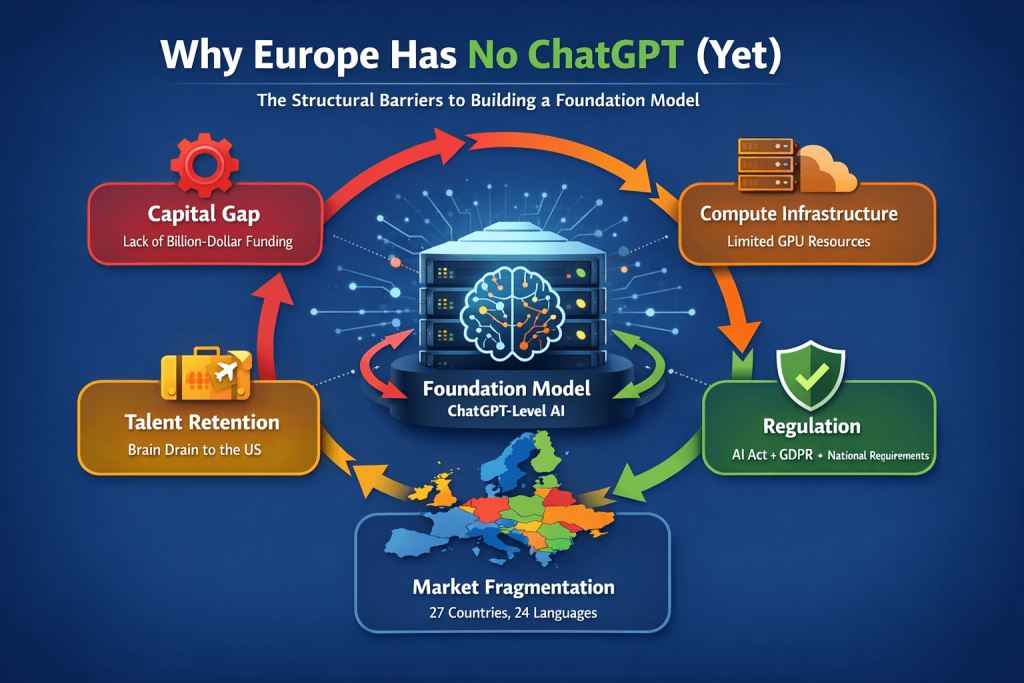
Europa hat kein eigenes ChatGPT. Und das liegt nicht an mangelndem Talent oder fehlendem Ehrgeiz. Es ist das Ergebnis struktureller Rahmenbedingungen, die sich über viele Jahre hinweg entwickelt haben — und sich nicht durch ein einzelnes Förderprogramm oder eine politische Rede lösen lassen. Wer verstehen möchte, warum europäische KI-Alternativen im Endkundenmarkt kaum sichtbar sind, muss fünf miteinander verknüpfte Faktoren betrachten.
Was „Alternative“ hier eigentlich bedeutet
Bevor die Ursachen betrachtet werden, ist es hilfreich, die Begrifflichkeiten zu klären. Viele Tools werben mit Bezeichnungen wie „European AI“ oder „AI Made in Germany“. Die meisten davon bewegen sich jedoch auf der Anwendungsebene — sie nutzen Backend-Modelle von OpenAI, Anthropic oder Google und ergänzen diese durch eigene Benutzeroberflächen, Datenschutzfunktionen oder branchenspezifische Features.
Das ist an sich nicht schlecht. Es unterscheidet sich aber grundlegend von einem Basismodell: einem großen Sprachmodell, das mit eigenen Daten, eigener Infrastruktur und eigenen Forschungsteams von Grund auf trainiert wird. ChatGPT basiert auf GPT-4o, einem solchen Basismodell. Wenn dieser Artikel von „echten Alternativen“ spricht, meint er diese Ebene und keine Anwendungen mit EU-Flagge.
Kapital: Der größte strukturelle Nachteil
Ein wettbewerbsfähiges Basismodell zu entwickeln erfordert Ressourcen in einer Größenordnung, die europäische Finanzierungsstrukturen selten ermöglichen. Seit 2023 hat OpenAI mehrere Finanzierungsrunden im Milliardenbereich abgeschlossen. Google, Meta und Microsoft investieren jährlich zweistellige Milliardenbeträge in KI-Infrastruktur und Forschung.
Europas Risikokapitalmarkt arbeitet in einer anderen Größenordnung. Einzelne Finanzierungsrunden über mehrere Hundert Millionen sind bereits außergewöhnlich. Mistral AI hat das mit seinen Finanzierungsrunden gezeigt und bleibt die Ausnahme. Europäische Investoren sind außerdem tendenziell risikoscheuer. In den USA ist die Bereitschaft deutlich größer, Hunderte Millionen in ein Unternehmen zu investieren, das möglicherweise erst nach Jahren profitabel wird.
So entsteht ein Teufelskreis. Ohne massive Finanzierung gibt es kein Modelltraining auf Weltniveau. Ohne Spitzenmodell kein überzeugendes Produkt. Ohne überzeugendes Produkt keine Nutzer und damit kein Argument für die nächste Finanzierungsrunde.
Rechenleistung und Cloud-Infrastruktur
Beim Training von Basismodellen laufen Tausende GPUs über Wochen oder Monate parallel. Diese Rechenkapazität wird fast vollständig von US-Hyperscalern kontrolliert: AWS, Microsoft Azure und Google Cloud. Europäische Cloud-Anbieter wie OVHcloud oder IONOS sind stark im traditionellen Hosting, bieten aber keine vergleichbare GPU-Infrastruktur für KI-Training.
Die EU hat das erkannt und Programme wie EuroHPC gestartet, um europäische Supercomputing-Kapazitäten aufzubauen. Das ist ein Anfang. Diese Initiativen richten sich aber vor allem an die Wissenschaft. Sie decken nicht den kommerziellen Bedarf ab, der nötig wäre, um mehrere Unternehmen mit eigenen Basismodellen gleichzeitig zu unterstützen. Wer heute in Europa ein großes Sprachmodell trainieren möchte, wird höchstwahrscheinlich GPU-Cluster bei einem US-Anbieter mieten.
Der Talentmarkt: Starke Ausbildung, schwache Bindung
Die europäischen Universitäten und Forschungseinrichtungen betreiben KI-Forschung von Weltrang. DeepMind wurde in London gegründet. Yann LeCun hat in Paris studiert. ETH Zürich, TU München, EPFL - die Qualität der Ausbildung ist international wettbewerbsfähig.
Das Problem liegt darin, Talente zu halten, nicht darin, sie auszubilden. US-Unternehmen bieten Gehälter und Unternehmensanteile, mit denen europäische Arbeitgeber selten mithalten können. Größere Teams, schnellere Karrierewege und der Zugang zu Infrastruktur, die es in Europa in dieser Form nicht gibt, verstärken diese Dynamik. Die Abwanderung von Fachkräften ist kein neues Phänomen. Im KI-Bereich fällt sie besonders stark aus, weil die Nachfrage nach Spezialisten das Angebot bei Weitem übersteigt.
Marktfragmentierung: 27 Länder, kein einheitlicher Markt
Ein US-amerikanisches Startup, das ein englischsprachiges Produkt auf den Markt bringt, erreicht sofort einen Markt von über 300 Millionen Menschen mit einem einheitlichen Rechtssystem, einer einheitlichen Sprache und einer einheitlichen Geschäftskultur. Ein europäisches Startup sieht sich 27 Ländern mit unterschiedlichen Sprachen, Vorschriften und Finanzierungsmechanismen gegenüber.
Die EU ist ein einheitlicher Markt für Waren. Für digitale Produkte - insbesondere KI-Anwendungen, die regulatorischen Anforderungen unterliegen - ist er nur teilweise vereinheitlicht. Förderprogramme sind national zersplittert. Beschaffungsprozesse folgen unterschiedlichen Logiken. Selbst innerhalb der EU variieren die Anforderungen an die Umsetzung des Datenschutzes je nach nationalen Aufsichtsbehörden. Das macht die Skalierung teurer und langsamer als in den USA oder China.
| Thema | Vereinigte Staaten | Europäische Union |
|---|---|---|
| Marktzugang | Ein einheitlicher Markt, über 330 Millionen Menschen | 27 Länder, fragmentierter Markt |
| Sprache | Eine Sprache für eine Produkteinführung | 24 Amtssprachen, Lokalisierung erforderlich |
| Rechtlicher Rahmen | Ein föderales System, ein Regelwerk | 27 nationale Auslegungen des EU-Rechts |
| Landschaft der Finanzierung | Multimilliarden-Dollar-Runden üblich | Finanzierungsrunden über 500 Mio. € bleiben die Ausnahme |
| Öffentliche Finanzierung | Zentralisierte Bundesprogramme (DARPA, NSF) | Zersplittert durch nationale und EU-Programme |
| Beschaffung | Einheitlicher föderaler Beschaffungsprozess | 27 verschiedene öffentliche Beschaffungssysteme |
| Regulatorische Belastung | Leichter, schneller auf dem Markt | AI Act + DSGVO + nationale Anforderungen |
| Bindung von Talenten | Hohe Gehälter, Unternehmensanteile, Visaprogramme | Abwanderung von Fachkräften in die USA, niedrigere Gehaltsobergrenze |
| Cloud-Infrastruktur | Hyperscaler mit Hauptsitz im Inland | Abhängig von US-Hyperscalern für den Zugriff auf GPUs |
| Zeit zum Skalieren | Einmal starten, sofort skalieren | Einführung in jedem einzelnen Land |
Regulierung: Hindernis oder Wettbewerbsvorteil?
Der AI Act, die DSGVO und verschiedene nationale Vorschriften schaffen einen Compliance-Rahmen, mit dem sich US-Startups nicht im selben Umfang auseinandersetzen müssen. Für ein junges Unternehmen mit begrenzten Ressourcen bedeutet jede zusätzliche regulatorische Anforderung weniger Budget für die Produktentwicklung.
Gleichzeitig hat das Gegenargument durchaus seine Berechtigung. Die Regulierung kann einen Vertrauensvorschuss schaffen. Unternehmen, die nachweislich DSGVO-konform arbeiten, haben in bestimmten Sektoren - Gesundheitswesen, Finanzen, öffentliche Verwaltung - einen klaren Vorteil gegenüber US-Anbietern, deren Datenverarbeitung nur teilweise europäischen Standards entspricht.
Die ehrliche Antwort ist, dass die Regulierung beides ist. Sie verlangsamt die Entwicklung von Verbraucherprodukten, schafft aber eine Grundlage für vertrauenswürdige B2B-Anwendungen. Wer erwartet, dass Europa ein zweites ChatGPT hervorbringt, wird wahrscheinlich enttäuscht sein. Wer nach souveränen KI-Lösungen für regulierte Branchen sucht, wird sie zunehmend hier finden.
Die europäische KI-Landschaft: Stand 2025/2026
Trotz der strukturellen Nachteile gibt es europäische Unternehmen, die eigene Basismodelle entwickeln. Die Auswahl ist klein, aber real.
Mistral AI (Frankreich) ist der bekannteste europäische Akteur. Das Unternehmen hat mehrere proprietäre Modelle veröffentlicht, darunter auch Open-Source-Varianten, und positioniert sich als leistungsstarke Alternative zu OpenAI mit Schwerpunkt auf dem API-Zugang für Entwickler und Unternehmen. Mistral konnte sich die größte KI-Finanzierungsrunde Europas sichern und arbeitet mit großen Cloud-Anbietern zusammen. Das Verbraucherprodukt (Le Chat) existiert zwar, ist aber nicht der strategische Schwerpunkt.
Aleph Alpha (Deutschland) hat sich bewusst auf Unternehmen und den öffentlichen Sektor spezialisiert. Statt im Endkundenmarkt mit ChatGPT zu konkurrieren, richtet sich das Unternehmen an regulierte Branchen und setzt auf eigenes Hosting und europäische Datensouveränität. Seine strategische Neuausrichtung in den letzten Jahren zeigt einen breiteren Trend: Europäische Anbieter haben durch Spezialisierung eher Erfolg als durch Wettbewerb im Massenmarkt.
Darüber hinaus gibt es kleinere Initiativen und Open-Source-Projekte, z. B. von Forschungseinrichtungen oder EU-finanzierten Konsortien. Diese sind für bestimmte Anwendungsfälle relevant, erscheinen aber nicht als Produkte für den Verbraucher.
Eine ausführliche Übersicht europäischer KI-Alternativen und spezialisierter Tools findest du hier:
Braucht Europa überhaupt einen eigenen ChatGPT?
Der Fokus liegt auf einer Eins-zu-eins-Kopie für Endnutzer, angetrieben von politischen Leitbildern wie digitaler Souveränität oder strategischer Unabhängigkeit.
Schwerpunkt auf Datenverarbeitung, Vertragskontrolle, Abhängigkeitsmanagement und risikobasierte Architekturentscheidungen.
Diese Frage wird oft reflexartig mit Ja beantwortet - digitale Souveränität, strategische Unabhängigkeit, europäische Werte. Die Argumente sind stichhaltig. Aber sie werden irreführend, wenn sie zu Forderungen nach einem Eins-zu-eins-Klon von ChatGPT führen.
Die strategisch relevantere Frage lautet: Wo braucht Europa tatsächlich eigene Modelle - und wo reicht eine souveräne Anwendungsschicht, die auf bestehenden Grundmodellen aufbaut? Bei den meisten Unternehmensanwendungen kommt es darauf an, wo die Daten verarbeitet werden, welche vertraglichen Rahmenbedingungen gelten und wie die Abhängigkeit von einzelnen Anbietern begrenzt wird. Dies erfordert nicht unbedingt ein europäisches Grundmodell, sondern vielmehr eine gut durchdachte Architektur.
Anders verhält es sich bei sicherheitskritischen Anwendungen - Verteidigung, Nachrichtendienste, kritische Infrastrukturen. Hier stellt die Abhängigkeit von US-Modellen ein echtes Risiko dar. In diesen Bereichen ist die digitale Souveränität auf der Modellebene wirklich relevant. Für den durchschnittlichen Geschäftsprozess ist sie das nur teilweise.
Was europäische Unternehmen jetzt tun können
Das Warten auf ein europäisches ChatGPT ist keine Strategie. Vier eher pragmatische Ansätze sind es:
Nutze US-Modelle DSGVO-konform. Mehrere Anbieter bieten inzwischen europäisches Hosting und Auftragsverarbeitungsverträge an, die die DSGVO-Anforderungen erfüllen. Die EU-Hosting-Optionen von OpenAI, Azure OpenAI Service mit europäischen Rechenzentren sowie vergleichbare Angebote von Anthropic und Google ermöglichen die Nutzung leistungsstarker Modelle innerhalb des europäischen Rechtsrahmens.
Prüfe europäische Anbieter für spezielle Anwendungsfälle. Unternehmen in regulierten Branchen oder mit höchsten Anforderungen an die Datensouveränität sollten Anbieter wie Mistral oder Aleph Alpha bewerten. Ihre Modelle sind für viele B2B-Anwendungen ausreichend leistungsfähig und bieten Vorteile bei Compliance und Vertragsgestaltung.
Vermeide die Bindung an einen einzigen Anbieter. Die KI-Landschaft verändert sich schnell. Wer sich heute vollständig an einen Anbieter bindet, kann in zwei Jahren Probleme bekommen, wenn sich Preise, Lizenzbedingungen oder Leistung ändern. Abstraktionsschichten und Architekturen mit mehreren Anbietern sind deshalb sinnvoll.
Baue Fachwissen auf, statt zu warten. Unternehmen, die jetzt mit KI experimentieren, auch mit US-Modellen, sammeln Erfahrungen, die sich später nicht einfach nachholen lassen. Die entscheidende Frage ist weniger „Welches Modell?“ als „Welcher Prozess profitiert davon?“.
Mehr zur praktischen Umsetzung und eine Übersicht konkreter europäischer Alternativen findest du hier.
Schlussfolgerung
Europa wird kurzfristig wahrscheinlich kein eigenes ChatGPT hervorbringen. Die Gründe sind strukturell: Kapital, Infrastruktur, das Halten von Talenten und die Marktfragmentierung greifen ineinander und lassen sich nicht isoliert lösen. Initiativen wie Mistral und Aleph Alpha zeigen, dass eigene Basismodelle möglich sind, allerdings mit anderen Prioritäten und einer anderen Marktpositionierung als ChatGPT.
Für die Unternehmen bedeutet dies, dass die bessere Strategie nicht im Abwarten, sondern in der souveränen Nutzung bestehender Modelle innerhalb des europäischen Rahmens besteht. Mit der richtigen Architektur können Leistung und Einhaltung von Vorschriften kombiniert werden, ohne dass man sich auf ein europäisches Äquivalent verlassen muss, das wahrscheinlich nicht so bald entstehen wird.