

More than 1.8 billion people worldwide use Gmail — including many in Europe. The service is free, reliable, and integrates seamlessly with other Google tools. Yet there is a fundamental issue: Gmail is difficult to reconcile with EU data protection law.
This is not about minor settings or configuration details. It concerns basic questions: Where are your emails stored? Who can access them? What happens to their contents? And what does this mean legally if you use Gmail for business purposes?
For many users, the answers are uncomfortable.
Is Gmail problematic for your use case?
Check the boxes that apply to you
The Core Issue: Data Processing Outside the EU
Google stores emails in data centers around the world — a significant portion of them in the United States. This creates a legal problem, because the GDPR allows personal data to be processed outside the EU only under strict conditions.
Since the Schrems II ruling in 2020, the so-called Privacy Shield — which was intended to legitimize data transfers to the US — has been invalid. Google now relies on Standard Contractual Clauses (SCCs) to safeguard international data transfers. These clauses are a recognized legal instrument, but they cannot prevent US authorities from accessing data under American law.
This is the crux of the problem. The GDPR requires a level of protection equivalent to EU standards. US surveillance laws such as FISA 702 and Executive Order 12333 conflict with this requirement. Google can implement technical safeguards, but the legal gap remains.
As of 2026, the EU–US Data Privacy Framework exists as a successor to the Privacy Shield. However, whether it will withstand judicial review remains uncertain. The legal situation can change on short notice.
Legal developments: From Snowden to today
How Gmail’s legal situation evolved over the past decade
💡 Key takeaway: The legal framework has been unstable for years. What’s considered compliant today might be challenged tomorrow.
Advertising Evaluation and Automated Analysis
In the past, the situation was clear: Google analyzed email content to display personalized advertising. According to Google, this practice ended in 2017 — at least for free Gmail accounts.
Does that mean Gmail no longer analyzes email content at all? No. Google continues to use automated systems to:
- filter spam and phishing attempts
- categorize emails (Promotions, Social, Updates)
- provide Smart Reply and Smart Compose
- detect security-related events such as suspicious logins
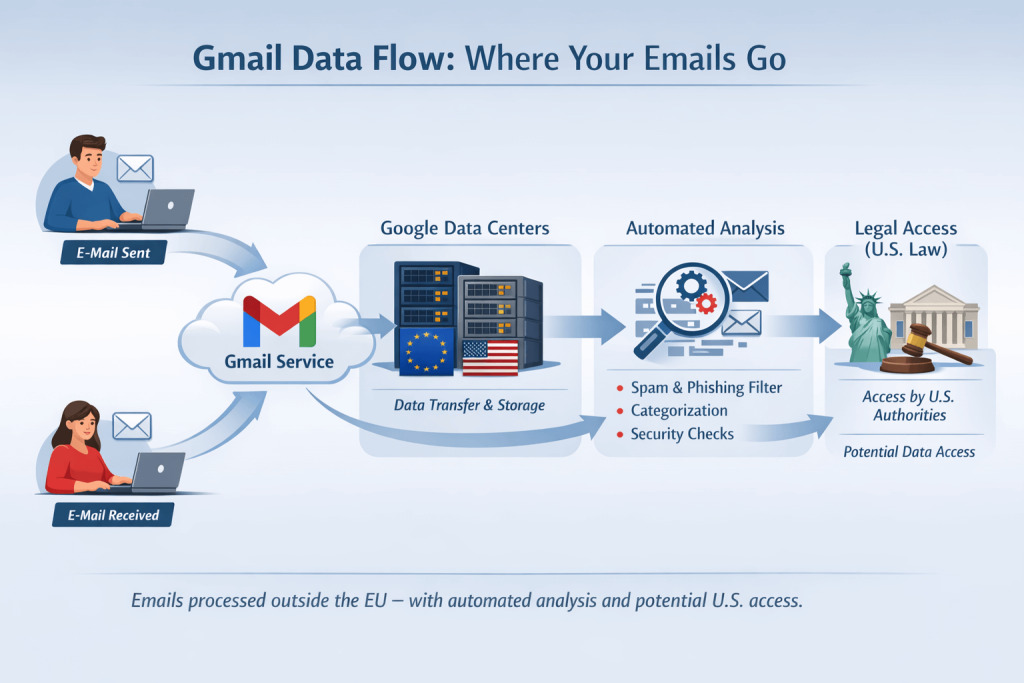
These functions require algorithms to scan email content. This is technically necessary — but still relevant from a data protection perspective. Even if Google no longer derives advertising directly from email contents, the data is still processed. And it is processed by a US company subject to legal frameworks that differ from those governing European providers.
You have very limited insight into which analyses take place in the background. Google’s privacy policies describe the general processes, but not the specific workings of the algorithms or the conclusions drawn from the data.
Lack of Privacy by Default
The GDPR requires “privacy by default” — services should be configured from the outset to process only the data that is strictly necessary.
This is not the case with Gmail. When you create an account, the following features are enabled by default:
- ad personalization (outside Gmail, but based on your Google account)
- web and app activity tracking
- location history (depending on device)
- YouTube history
You can change these settings — but only if you actively do so. And even if you disable everything, the core issue remains: Google processes your emails on servers outside the EU, under US law.
“Privacy by default” also means that sensitive data should be protected automatically. With Gmail, that responsibility lies with the user. This runs counter to the fundamental intent of the GDPR.
Data Processing Agreements and the DPA Issue
If you use Gmail for business purposes, another problem arises. Legally, you are the “data controller” under the GDPR, while Google acts as your “data processor”. This requires a Data Processing Agreement (DPA).
A DPA defines how a service provider may handle your data. Google offers such an agreement for Google Workspace (the paid business version). Free Gmail accounts do not include a DPA — which alone makes business use legally problematic.
But even with a DPA, the underlying issue remains: Google processes data in the United States. A DPA can obligate Google to certain safeguards, but it cannot prevent US authorities from requesting access under specific circumstances.
There is also a question of control. A DPA assumes that you retain control over the data. With Gmail, this is debatable. You can delete emails — but do you have transparency regarding where copies are stored, which backups exist, or how long metadata is retained?
For companies that exchange sensitive customer data or personal information via email, this becomes critical. Consider a tax advisory firm using Gmail to communicate with clients. Income statements, tax returns, and personal details are transmitted by email. Legally, this represents a risk — even with a DPA in place.
What This Means in Practice
How problematic Gmail is depends on how you use it. A realistic assessment looks like this:
| Usage context | Risk assessment | Recommendation |
|---|---|---|
| Private use, no sensitive data | Legally uncritical, but limited privacy protection | Acceptable if data protection is not a top priority |
| Private use involving sensitive topics | Medium risk – personal data is processed on US servers | Consider an alternative if privacy is important to you |
| Small businesses / sole traders, general communication | Medium to high risk – no DPA for free Gmail accounts | Google Workspace with DPA or switch to an EU-based provider |
| Companies handling customer data, health data, etc. | High risk – GDPR conflicts likely | Switching to EU-based hosting is strongly recommended |
The distinction matters. Not every Gmail use case is immediately unlawful. But the more sensitive the data and the more professional the context, the greater the risk.
In recent years, data protection authorities have increasingly scrutinized US-based services. There have been fines imposed on companies that transferred personal data to the US without adequate legal safeguards. Gmail itself has rarely been the direct target of enforcement actions so far — but the underlying legal issue remains.
Common Misconceptions About Gmail and GDPR
“Google Workspace is GDPR-compliant, so everything is fine.”
Google Workspace provides a DPA and additional administrative controls, which improves the situation. But it does not eliminate the issue of data processing in the US. Even if data is stored in European data centers, Google reserves the right to access it from the US. A DPA mitigates certain risks — not all of them.
“If I use encryption, Gmail is unproblematic from a privacy perspective.”
Encryption helps, but only to a degree. Gmail uses transport encryption (TLS), meaning emails are encrypted in transit. On Google’s servers, however, emails are stored unencrypted so that features like search and Smart Reply can function. Gmail does not offer end-to-end encryption (E2EE) by default. External tools such as PGP are theoretically possible, but rarely used — and they do not solve the metadata problem (sender, recipient, timestamps).
“I can use Gmail privately without concerns.”
Only partially true. For purely private use, the GDPR does not apply in full. But as soon as you send business-related emails or process personal data of others, it becomes relevant. For example, if you organize a club meeting and email names and addresses via Gmail, you act as a data controller — and the GDPR applies.
Decision Guide: When Does Switching Make Sense?
Whether you should continue using Gmail depends on several factors:
- How sensitive is your data? Newsletters and confirmations are less critical than payroll data or medical records.
- Do you use Gmail for business? Then you need at least Google Workspace with a DPA — or preferably an EU-based alternative.
- How important is control over your data? With Gmail, Google has technical access — always.
- Are you willing to trade convenience for privacy? Gmail is convenient. Alternatives often require adjustment.
If you decide against Gmail, there are European providers that focus on GDPR compliance, operate servers within the EU, and do not perform advertising-related analysis.
You can find an overview here: Alternative to Google Gmail
Gmail is not illegal per se — but it is difficult to reconcile with the GDPR. Those who understand and consciously accept the risk may continue using it. Those who must protect sensitive data should consider switching.
Comparison table: Gmail vs. EU alternatives
| Criterion | Gmail (free) | Gmail (Workspace) | EU alternative (example) |
|---|---|---|---|
| Server location | Global, primarily US | Selectable, but US access possible | EU only |
| Data Processing Agreement (DPA) | No | Yes | Yes |
| Advertising analysis | Limited | No (according to Google) | No |
| End-to-end encryption | No | No | Partially available |
| Cost | Free | From approx. €6 / month | Often €1–3 / month |